

Spotlight on Southwest Virginia’s New River Valley: The Lewis Mill of Carroll County
News originally published by
Virginia Department of Historic ResourcesThe Lewis Mill is one of the few remaining 19th-century water-powered grist mills in Southwest Virginia. Built during the Civil War, the mill helped power a small community in the region into the 20th century before closing in 1942.
By Michael Pulice | DHR Architectural Historian for Virginia’s Western Region
The Lewis Mill is sited along the bank of Rock Creek, a tributary of Little Reed Island Creek and the New River, at the center of the tiny, faded community of Sylvatus, which is located between Hillsville and Pulaski. Beginning in the mid-1850s, Sylvatus was a vibrant place due to the presence of the Betty Baker copper and iron mine and a railroad spur that served it, as well as the Lewis Mill (Fig. 1) that soon followed. Such small-time grain mills were very common in rural areas. They supported commercial and subsistence agriculture, as well as domestic food preparation, and were important to the local economy.
The two-story Lewis Mill has a heavy timber-frame structure dating to 1864, with an added gabled extension in the front (detectable on the interior), and a one-story light-frame shed extension along the full depth of its north flank with its own front entrance. The water wheel is missing, but it was located on the south side of the mill, near remnants of a tail race leading back toward the creek. While the condition of the mill is fair, some stabilization work having been done at the basement level in recent years; the mill is remarkable for its intactness and historic integrity, including its interior, which contains a wide variety of milling equipment.
Although originally featuring only one “run” or pair of stones, for corn, the building was occasionally upgraded, beginning in 1919, to include different devices for milling corn, wheat, buckwheat, and animal feeds. These machines, all powered by a main shaft turned by the water wheel, included two early sets of burr millstones for flour and cornmeal, roller mill equipment patented in the 1880s to produce white flour faster and more efficiently, and of a later era, a circa 1930s Midget Marvel Mill (Fig. 2). The Marvel is a self-contained roller flour milling machine said to weigh at least 6,000 pounds, and which, according to company marketing, “will make more high-grade flour out of a bushel of wheat than any other mill.” Within its heavy cast-iron frame is an array of gears, rolls, and reels. The apparatus was designed by Englishman A. R. Tattersall in London, touted as “the world’s greatest milling engineer,” and was manufactured under license by the Anglo American Mill Co. of Owensboro, Kentucky. After the first models were introduced in 1920 (Fig. 3) new versions were redesigned to be more simple, efficient, and less costly to manufacture. In doing so, Midget Marvels were essentially stripped of their original antique character and visual appeal. This is just one example of the effects of modernization and mechanization that seemingly touched everything in American life during the period. Nevertheless, the machine contributed to Lewis Mill’s economy and diversity of products, and likely aided in prolonging its profitable operation into the mid-20th century, when most small-time mills closed for business.

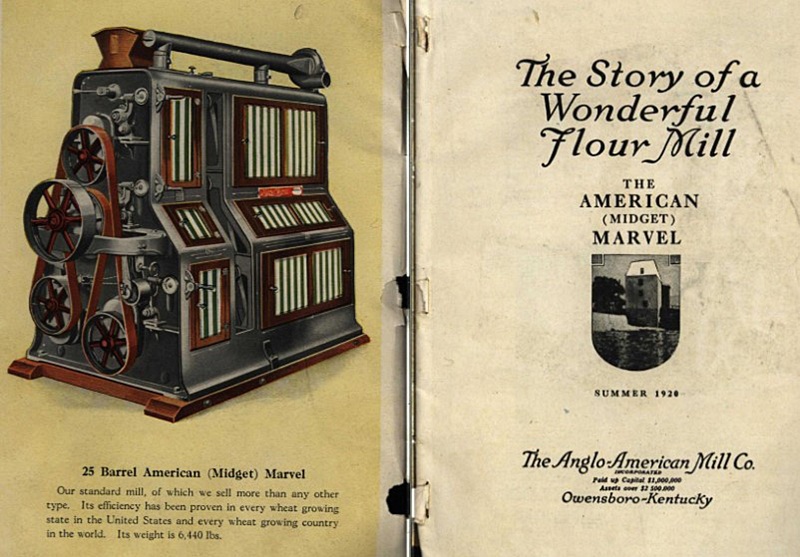
later model. The weight of the unit is 6,440 lbs. Credit: 1920 marketing booklet, Archive.org
The Lewis Mill serves as an educational representation of centuries-old water-power and millstone technology, as well as changing national trends during its productive years that affected the purchase of new types of machinery and the character of its milled products. Throughout the first half of 20th century, centralized, industrial-scale merchant mills effectively marketed their facilities as being sanitary and their products as safe and healthy to eat while implying that small-time mills, which they were running out of business, were much less so. Modern mills used various means—not all of them ethical—to produce ever whiter flour for factory-made bread, which quickly took over the marketplace, essentially replacing traditional home-made bread; this happened despite the fact that bleached and refined flours were certainly less healthy to eat. By the 1880s, commercial mills had begun removing nutritional components such as bran and germ, and thus the oils concentrated in the germ, to make flour whiter and to increase shelf life. Some of the lost nutrients were replaced, artificially, through a process cleverly promoted as “enrichment.” To compensate for the loss of flavor, increasing amounts of sugar and other additives would be used in baking.
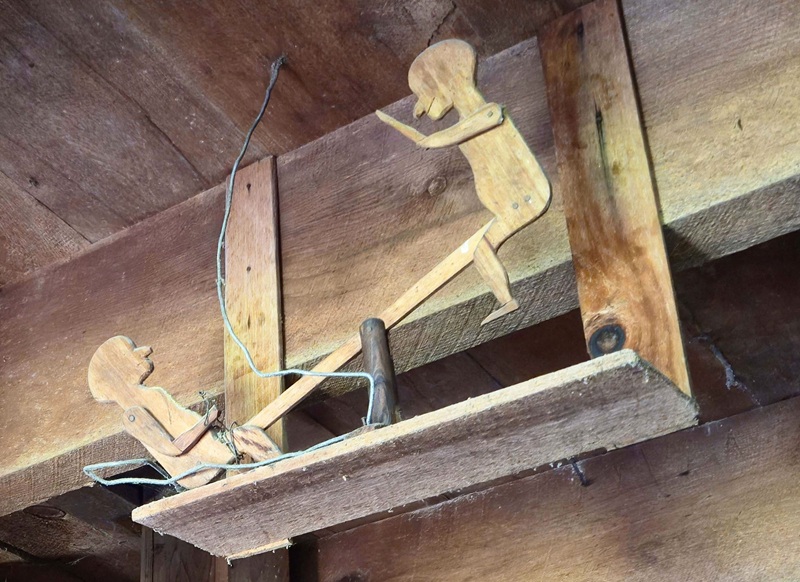
The interior of Lewis Mill contains significant milling equipment. While the mill was under operation, the miller stood on a sunken platform in front of the millstones, filling cornmeal into sacks with a flat wooden paddle. Farmers from the surrounding community brought their grains to the mill for processing in exchange for a portion of the product to be retained and sold by the mill under one of several brand names packaged in colorful, cheerfully artistic paper bags (Fig. 4). The initials H. R., presumably those of the original miller (full name unknown) are burned into the millstone crane in a rear corner of the main floor. An odd-looking circa 1920 iron contraption called an ozone generator, a combined electrical and mechanical device used for bleaching flour (among numerous other purported uses) is also found within the mill. A playful, carved wooden fixture, “seesaw men”, handmade by miller George W. Lewis hangs overhead from a floor joist. It is connected by a wire to the milling equipment to alert Lewis if a roller belt slipped off (Fig. 5). Lewis purchased the mill in 1919 from E. D. Worrell, who had owned it for only two years, for $5,500. Lewis made major investments in the mill, which he ran six days a week and made a profitable business. It was likely he who added the four front windows. Prior to then, it had only two second-story front openings lacking window sashes or glass panes.

On the first and second floors of the Lewis Mill are the components of a Griscom roller milling system dating to 1884. The grain-processing and flour-milling equipment was manufactured by the Philadelphia-based firm Griscom & Co. (also known as Griscom & McFeely). The company served as “prominent mill builders, furnishers, and contractors for flour mill construction.” They supplied complete rolling systems, oscillator sieve bolters, flour dressers, elevator heads, and the like. On the upper floor are devices made by Howes, Babcock & Ewell of Silver Creek, New York, home to large-scale manufacturers of milling equipment. The roller-mill pieces include a Eureka Dustless Receiving Separator, where both wheat and buckwheat were run through a cleaner with a blower, from which impurities like chaff and weed seeds were blown out of a discharge chute, as well as a phosphate dispenser used in the flour-bleaching process.
The Lewis Mill ceased to operate around 1942, and the mill dam washed out during a flood in 1944, permanently putting an end to the mill’s operation. The property continues to be owned and maintained by the Lewis family, to whom its place in family history and its long-term preservation are important considerations. A tangible reminder of simpler times, it is the only water-powered mill known to have survived in Carroll County, where dozens likely existed during the 19th century.
Sources
- Rita Gail Lewis, personal communication and Lewis Mill documentation, August 2026.
- Cunningham, Jim. “Lewis Mill Manor Is” The Carroll News, Hillsville, July 14, 1977. DHR Archives.
- Ricky Cox, personal communication regarding water-powered mills and local history, August-October, 2026.
- Marketing booklet: "The Story of a Wonderful Flour Mill: The American (Midget) Marvel." Anglo-American Mill Co. Owensboro Kentucky, Summer 1920. Archive.org
Legal Disclaimer:
EIN Presswire provides this news content "as is" without warranty of any kind. We do not accept any responsibility or liability for the accuracy, content, images, videos, licenses, completeness, legality, or reliability of the information contained in this article. If you have any complaints or copyright issues related to this article, kindly contact the author above.
